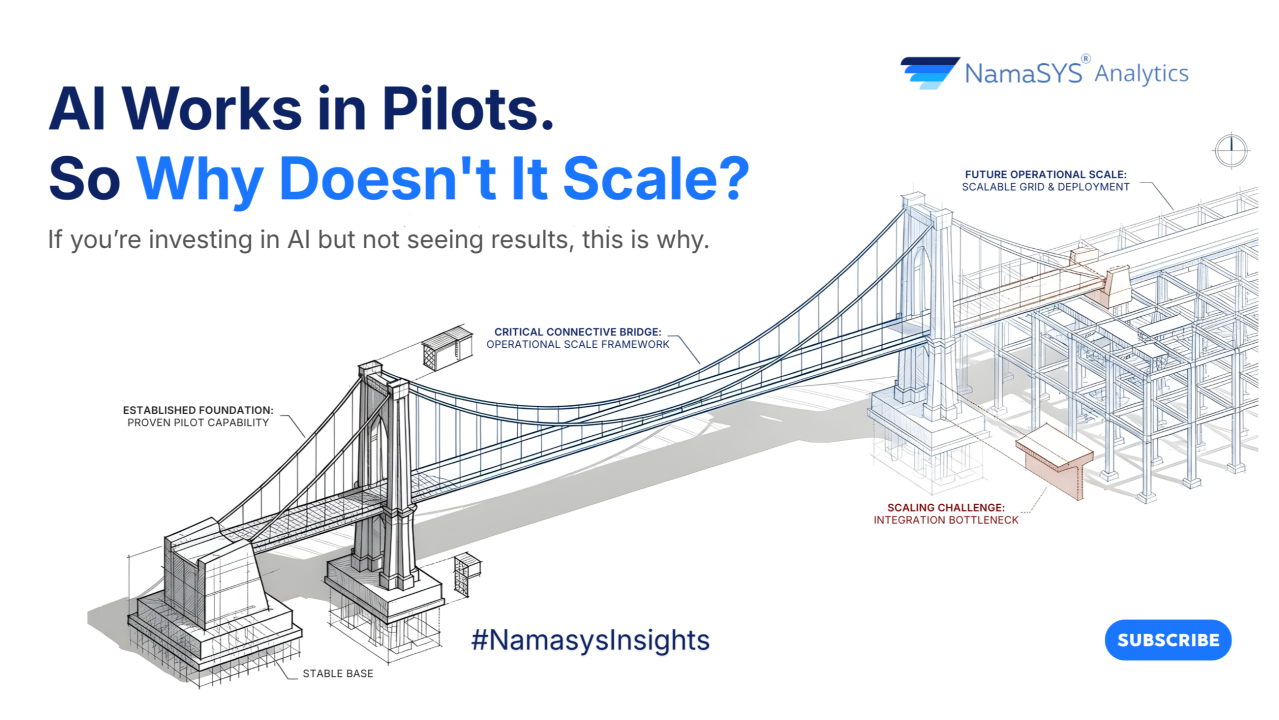
Over 80% of AI projects fail to reach production or deliver the expected value.
Yet according to a report, over 70% of organizations have already adopted AI in at least one function.
Investment keeps rising. Ambition keeps rising. And still, only a fraction are realizing a measurable, enterprise-wide impact.
That gap, between capability and outcomes, is now a board-level concern.
Most organizations aren't failing at AI. They're succeeding in isolation.
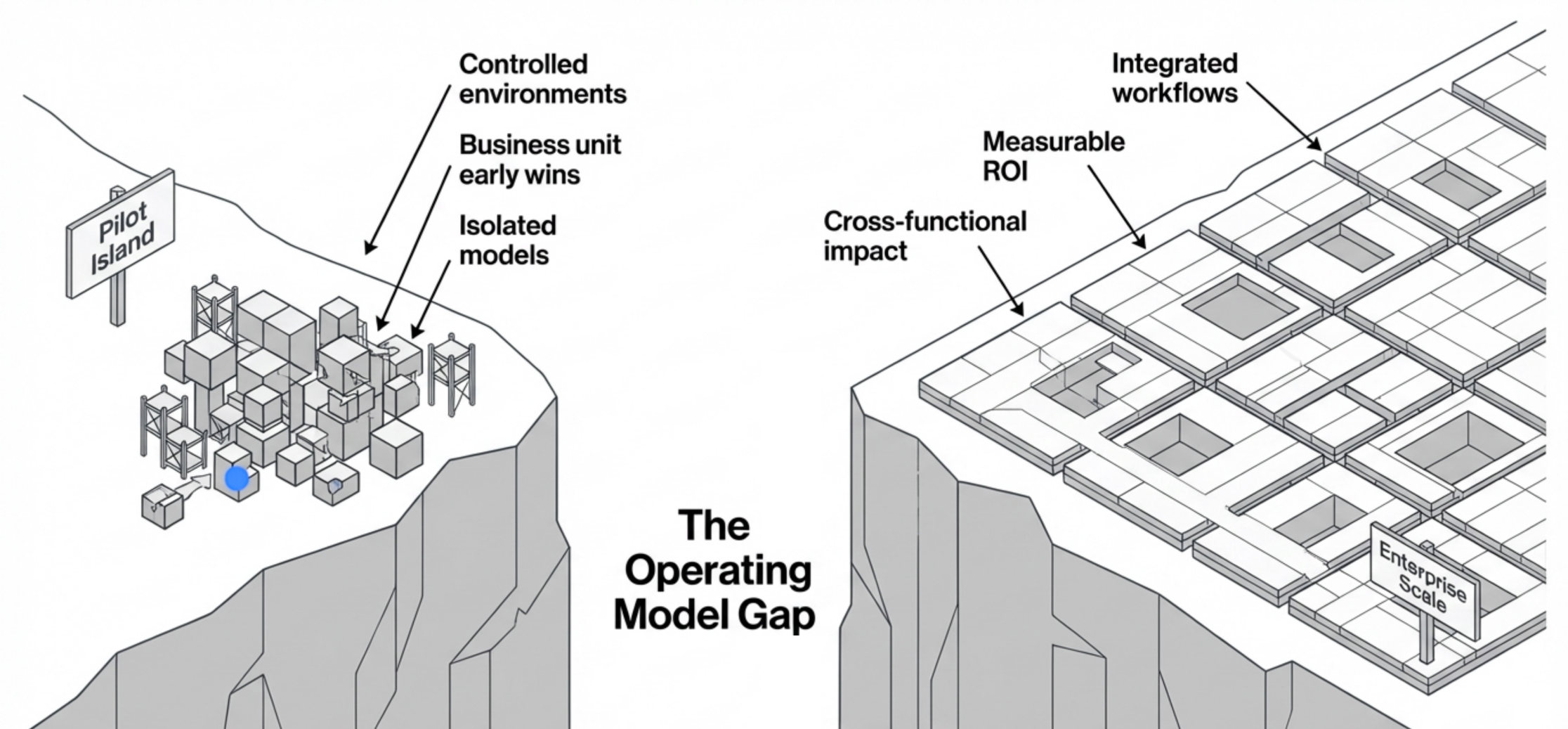
Pilots show strong results. Models perform in controlled environments. Use cases demonstrate real promise. Business units celebrate early wins.
But when it comes to scaling across functions, geographies, and decision systems, progress stalls.
What works in a controlled proof-of-concept doesn't necessarily translate into an enterprise-wide change. And leadership is left wondering why the returns haven't materialized.
The issue isn't experimentation. It's operationalization.
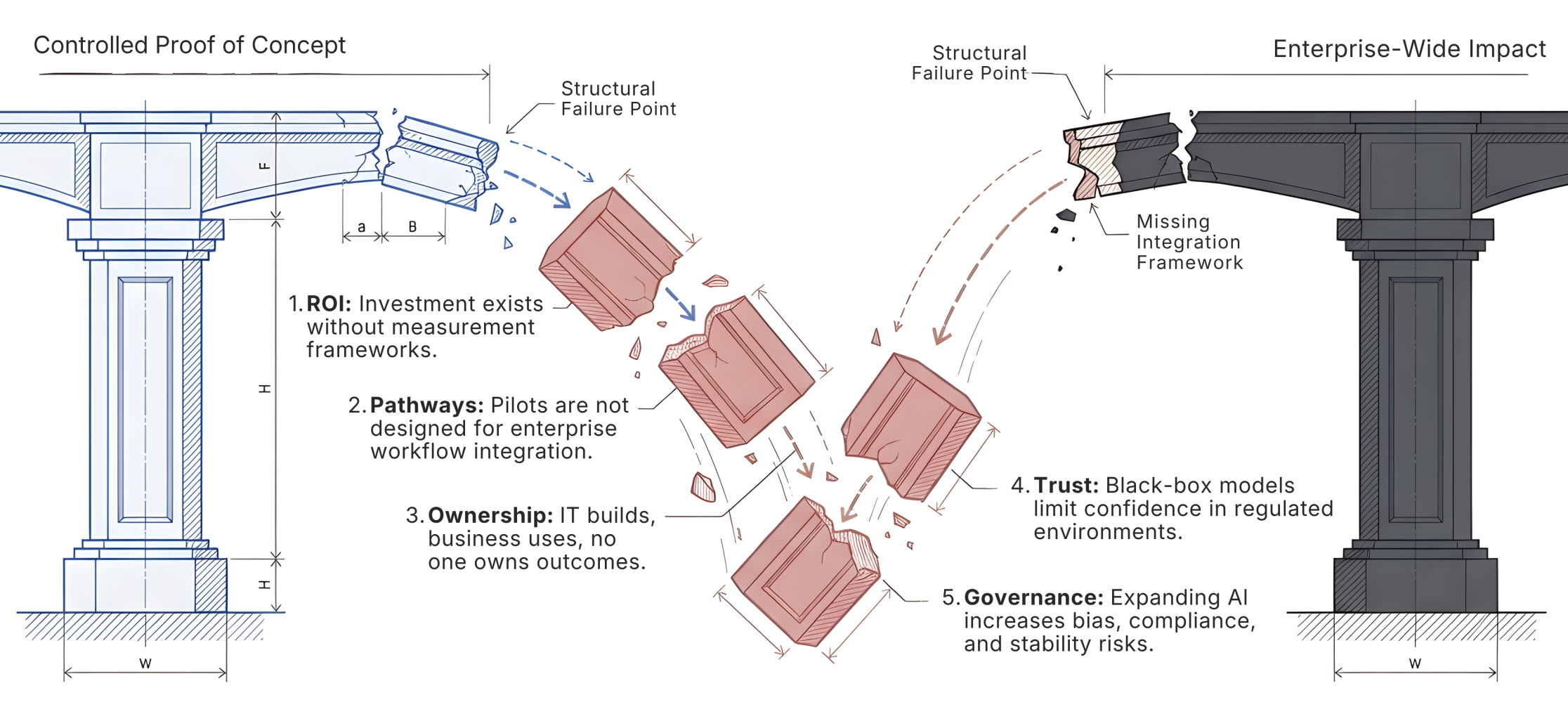
The failure patterns are consistent across industries:
ROI without measurement — AI investment exists, but no framework to track business impact across revenue, cost, risk, or productivity
Pilots without pathways — successful use cases are never designed for integration into enterprise workflows
Ownership without accountability — IT builds, business uses, no one owns outcomes
Intelligence without trust — black-box models limit decision confidence, especially in regulated environments
Scale without governance — as AI expands, so do risks around bias, compliance exposure, and operational instability
Notice what's absent from all five: a technology problem.
MIT Technology Review puts it plainly: the biggest barrier to AI success isn't the technology. It's organizational readiness and integration.
The real problem is the operating model gap.
AI doesn't fail because models are weak. It fails because organizations aren't structured to run it.
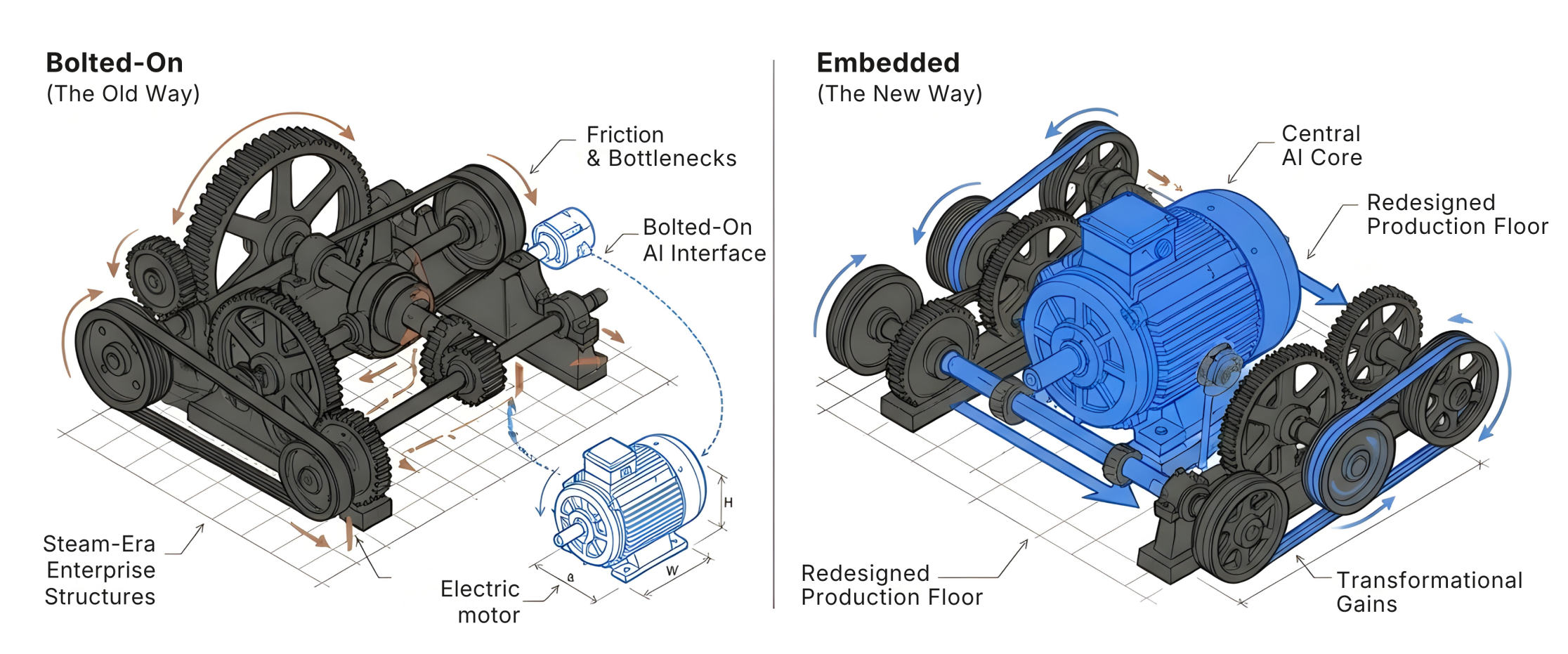
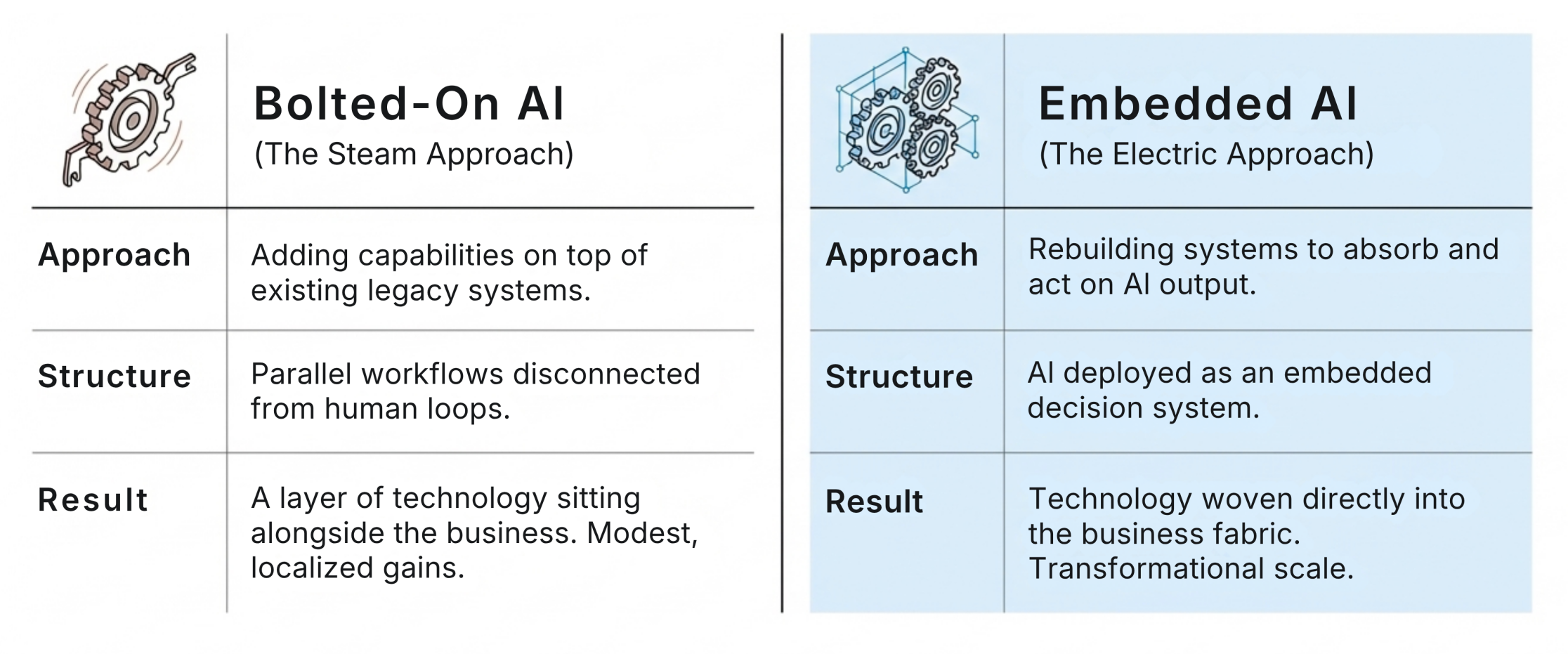
Think of electricity in the early 20th century.
Factories that bolted electric motors onto existing steam-era machines saw modest gains. The ones that redesigned their entire production floor around electricity, the layout, the workflows, the roles, saw transformational gains.
The technology was identical. The operating model was not.
Most organizations today are bolting AI onto steam-era structures.
Research reinforces that companies capturing value from AI are not just deploying algorithms but also redesigning processes and operating models.
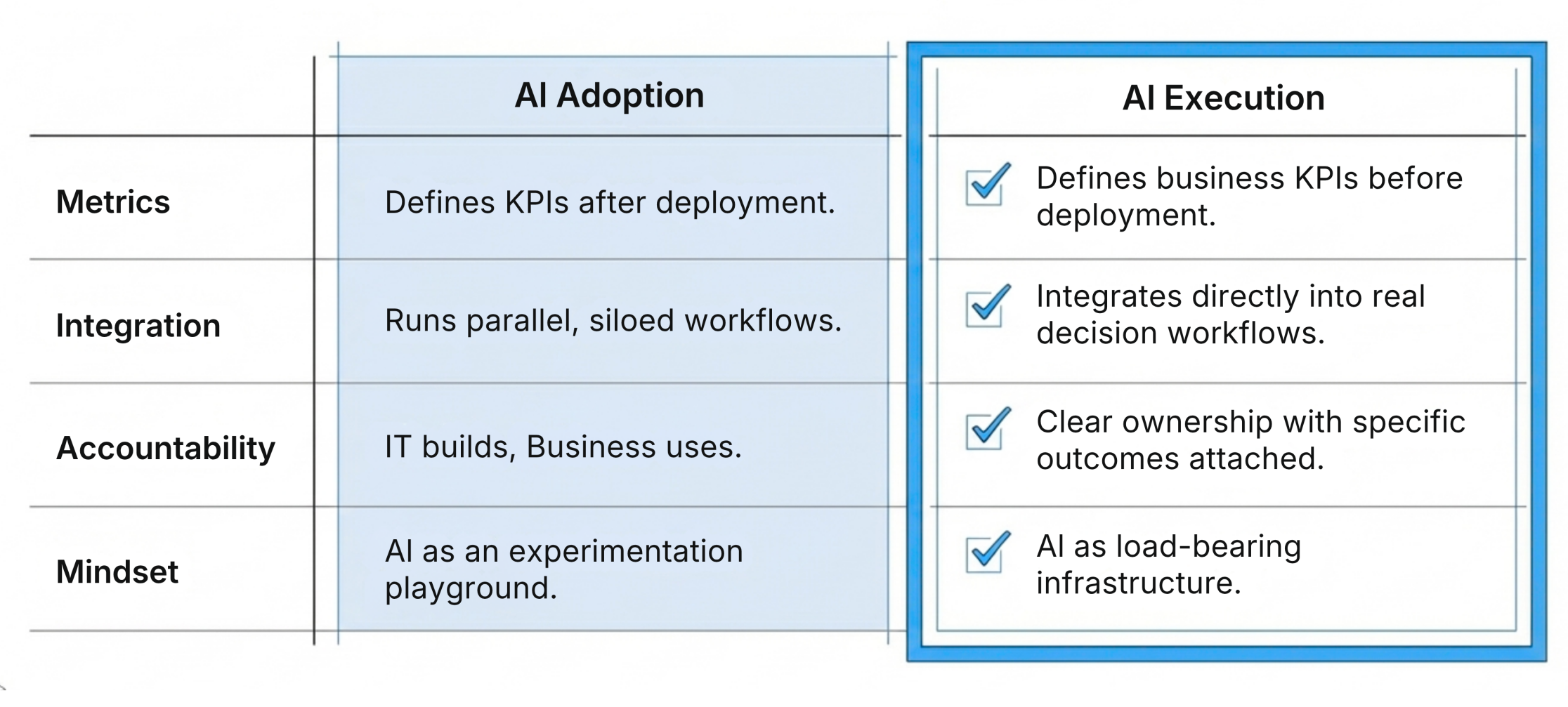
What the organizations pulling ahead are doing differently:
This is the shift from AI adoption to AI execution.
After working with leadership teams across BFSI, healthcare, HR, and various industries, the pattern is always the same.
The organizations that struggle aren't short on AI capability. They're short on the operational infrastructure to translate that capability into decisions and decisions into outcomes.
That's the problem we solve. Not by adding more AI, but by building the system around it.
Operating models designed for scale. Measurement frameworks tied to business outcomes. Governance embedded from day one, not retrofitted later.
Because the competitive advantage in AI isn't who has the best model. It's the one who has built the best system to run it.
The question worth asking:
Is AI part of how your business makes decisions, or just another layer of technology?
We'd love to hear from you, are you seeing this pattern in your organization? Where is AI scaling well, and where is it hitting walls? Share your experience in the comments.
Sources: McKinsey & Company · Gartner · Deloitte · MIT Technology Review · BCG
As enterprises connect AI agents to live workflows, security risks extend beyond the model. Learn how prompt injection, excessive access, weak governance and poor oversight can expose business systems—and how leaders can secure AI agents from the start.
Generic AI improves productivity, but industry-specific AI creates measurable business value by combining enterprise data, workflows, governance and domain expertise. Explore why context will define the next phase of AI adoption.
Namasys Powers What’s Next for Your Enterprise
Bring clarity, efficiency, and agility to every department. With Namasys, your teams are empowered by AI that works in sync with enterprise systems and strategy.